Shims leak. Native code does not.
Verisoul catches injected JavaScript shims four ways. Real Chrome properties are native C++ bindings.
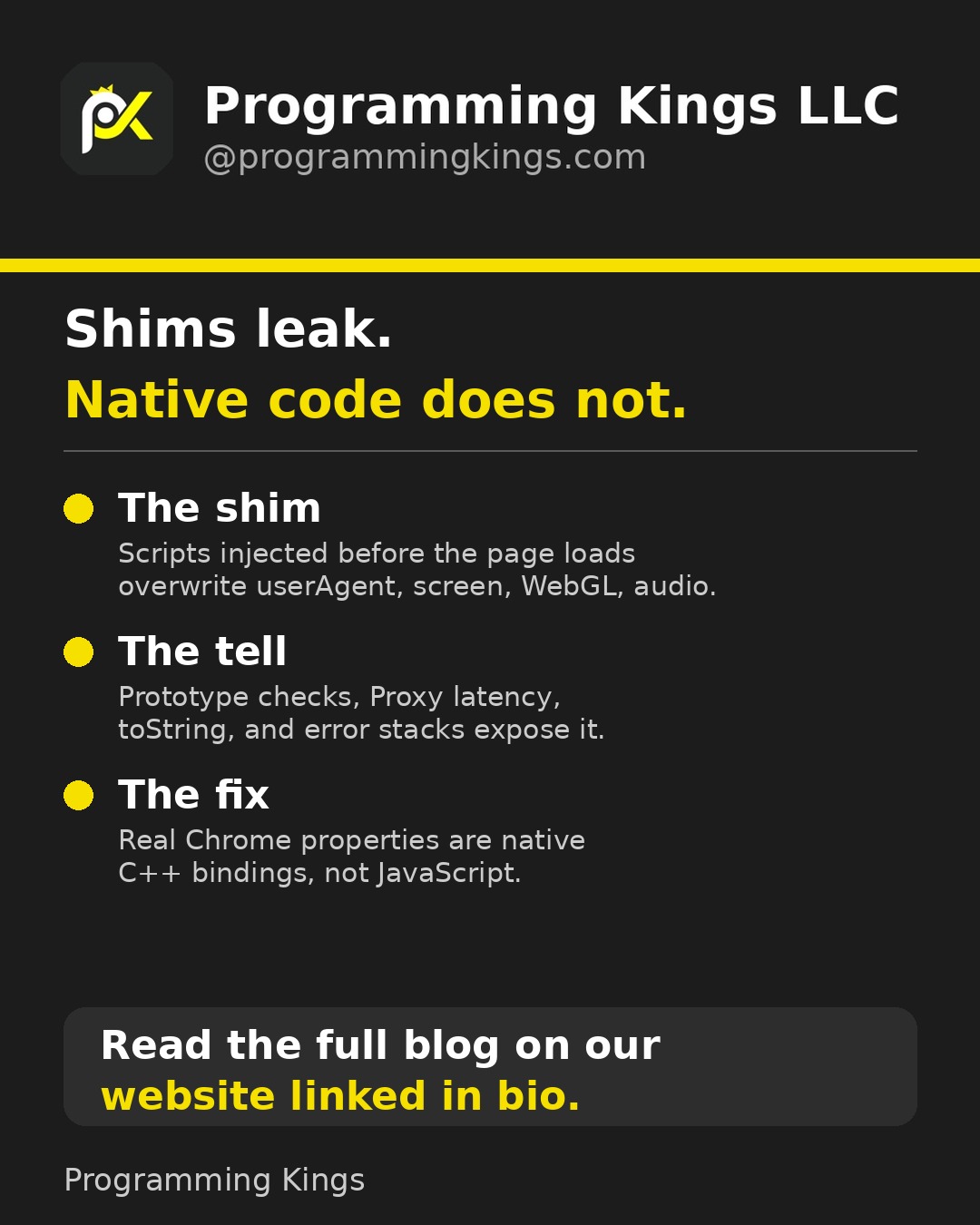
Shims leak. Native code does not.
Your anti-detect browser changes your fingerprint with JavaScript injected before the page loads. That injection is the fingerprint now.
Commercial tools overwrite navigator.userAgent, navigator.platform, hardwareConcurrency, screen size, WebGL parameters, and audio data through scripts added with Page.addScriptToEvaluateOnNewDocument. In a genuine browser, those properties are native C++ bindings, not JavaScript.
Verisoul catches the difference four ways. It inspects prototype chains for irregular descriptors. It probes Proxy wrappers, which add microsecond latency. It checks Function.prototype.toString, which must return native code. And it forces an error inside an overridden function, so the call stack points straight at the injected content script.
We wrote this blog to show why no profile setting can fix this. The shim lives in the runtime, so every profile built on it carries the same trace. We tested Dolphin, AdsPower, Octo, and Multilogin across Windows, macOS, and Linux, all OS profiles, headed and headless, against genuine Chrome.
Software Prince engineers custom Chromium builds from source, with properties that exist as true native C++ bindings, because the engine has to be coherent, not patched after the fact.
If you are looking for multi-account work that stops getting flagged, book a short call below.
Your anti-detect browser changes your fingerprint with JavaScript injected before the page loads. That injection is the fingerprint now.
Commercial tools overwrite navigator.userAgent, navigator.platform, hardwareConcurrency, screen size, WebGL parameters, and audio data through scripts added with Page.addScriptToEvaluateOnNewDocument. In a genuine browser, those properties are native C++ bindings, not JavaScript.
Verisoul catches the difference four ways. It inspects prototype chains for irregular descriptors. It probes Proxy wrappers, which add microsecond latency. It checks Function.prototype.toString, which must return native code. And it forces an error inside an overridden function, so the call stack points straight at the injected content script.
We wrote this blog to show why no profile setting can fix this. The shim lives in the runtime, so every profile built on it carries the same trace. We tested Dolphin, AdsPower, Octo, and Multilogin across Windows, macOS, and Linux, all OS profiles, headed and headless, against genuine Chrome.
Software Prince engineers custom Chromium builds from source, with properties that exist as true native C++ bindings, because the engine has to be coherent, not patched after the fact.
If you are looking for multi-account work that stops getting flagged, book a short call below.
Tap heart to appreciate
Share & View on Social ↓



























Our Social Media Channels
Follow this story and join the discussion across our verified networks: